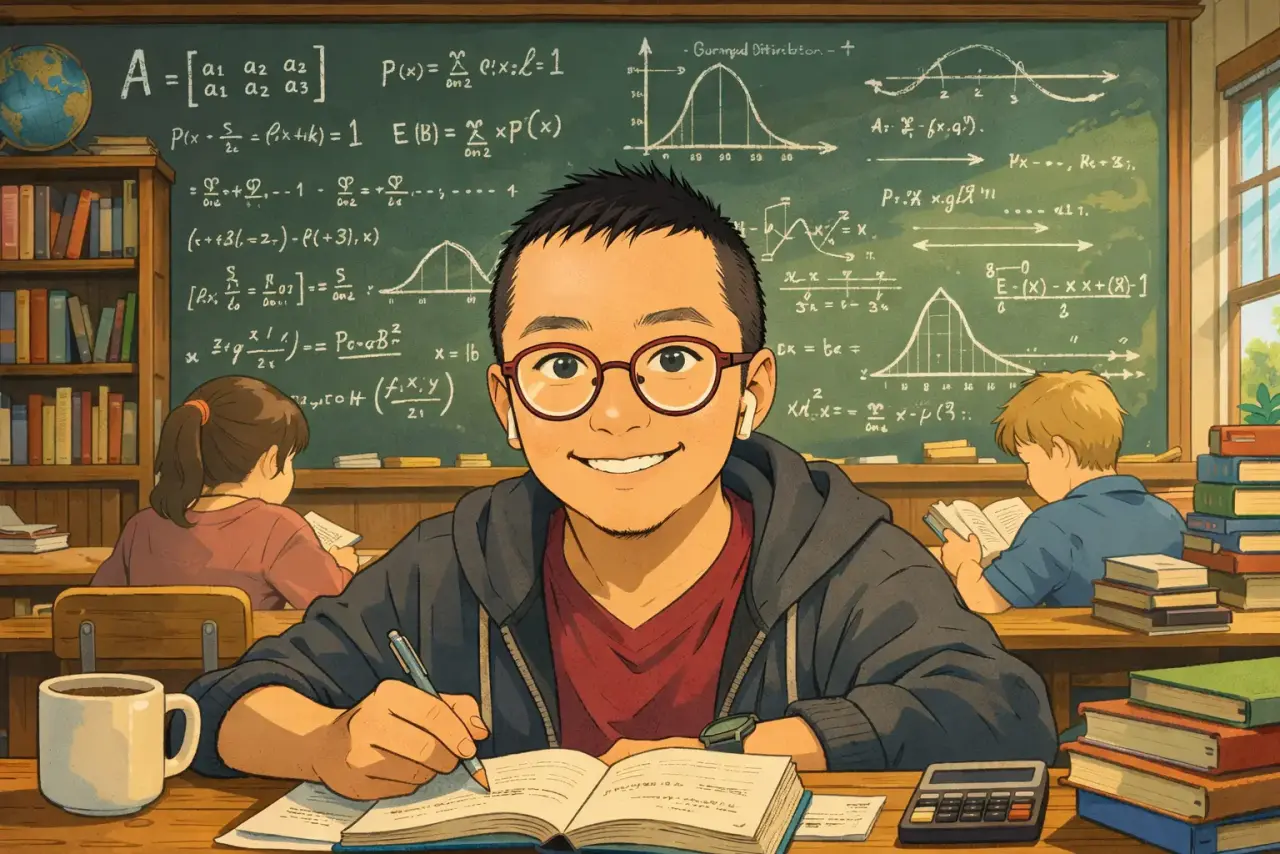
I recently finished Part I of Deep Learning by Goodfellow, Bengio, and Courville. It works best as a compact pass through the mathematical background the reader is expected to carry forward. It also clarified what I still want from the later chapters: not just results and terminology, but more of the reasoning behind them.
Shared Vocabulary for Later Chapters
The most useful part for me was the quick pass through linear algebra, probability, and numerical computation. Those topics are easy to treat as background, and this section put the shared vocabulary back in view without turning into a long detour. The numerical-computation chapter was a good example: conditioning, overflow, and underflow show up as practical constraints, not isolated math trivia.
Chapter 5 was especially helpful in that respect. It reconnects the mathematical preliminaries to actual machine learning problems instead of leaving them as isolated review material. That made Part I feel like a reset of the vocabulary the later chapters will build on.
Working Through the Derivations
I want to spend more time working through why the results hold, using proofs or proof sketches rather than stopping at the statements. I am treating Part I as a map for the later chapters, with separate notes or references when I want to follow a derivation in more detail.
Get new posts by email
Occasional updates when I publish something new.
Follow.it sends the emails and includes an unsubscribe link.
Related posts
Dropout as Shared-Parameter Bagging
March 7, 2026
A concrete way to understand dropout in deep learning: sampled subnetworks with shared weights, standing in for a much more expensive ensemble.
Depth Changes Scaling, Not Just Capacity
February 15, 2026
Chapter 6 of Deep Learning separates representational capacity, parameter efficiency, and learnability—and shows why depth changes scaling, not just expressiveness.
Camping Indoors in San Francisco
April 27, 2026
My first week in San Francisco: paperwork, an unfurnished apartment, two cats, Bay Trail runs, and waiting for furniture.